

Hormone medicines
Toremifene
A selective estrogen-receptor modulator approved for a defined metastatic breast-cancer setting, with a boxed warning about potentially dangerous QT prolongation.
Large randomized breast-cancer comparisons plus current US labeling; outcomes differ by trial
Also known as: Fareston
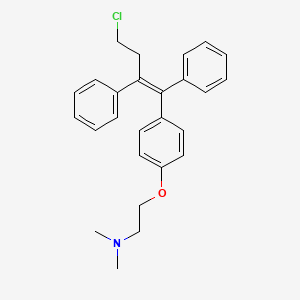
Practical use
Evidence interpretation and clinical context
- Keep the cancer population visible
- Do not detach a result from tumor status and menopausal context.
- Read the cardiac warning
- QT and interaction findings materially affect the medicine’s risk profile.
- Avoid flattening mixed endpoints
- Response, progression and survival need separate descriptions.
Overview
Toremifene has estrogen agonist and antagonist effects that depend on tissue context. The US Fareston indication concerns postmenopausal women with metastatic breast cancer whose tumors are estrogen-receptor positive or of unknown status.
Risks and limitations
The boxed warning concerns QT prolongation that can lead to serious arrhythmia, fainting, seizures or death. The label also addresses liver injury, uterine malignancy and clinically important interactions. These risks cannot be dismissed because another SERM has a different reputation.
How to read this
Comparative breast-cancer trials answer questions about tumor response and progression in patients with cancer. They do not establish a post-cycle recovery strategy or a general-purpose estrogen-control product.
Research explained
A phase III comparison of two toremifene doses to tamoxifen in postmenopausal women with advanced breast cancer. Eastern European Study Group.
Who was studied
463 postmenopausal women with advanced estrogen-receptor positive or unknown breast cancer in an open-label randomized trial.
What was found
The principal toremifene comparison had efficacy similar to tamoxifen for response and time to progression. A higher-exposure arm did not significantly improve those outcomes over tamoxifen.
What it cannot establish
Open-label assessment and the advanced-cancer setting limit transfer to other populations or purposes.
Read the original studyComparison of toremifene and tamoxifen in post-menopausal patients with advanced breast cancer: a randomized double-blind, the 'nordic' phase III study.
Who was studied
415 postmenopausal patients with advanced breast cancer in a blinded Nordic phase 3 comparison.
What was found
Response and overall survival did not significantly differ. Median progression time favored tamoxifen in the overall analysis; the estrogen-receptor-positive subgroup did not show that difference.
What it cannot establish
Subgroup and discontinuation patterns complicate a simple equivalence claim. A nonsignificant survival result does not prove the drugs are identical in every outcome.
Read the original studyCurrent US indication
Fareston is labeled for the specified metastatic breast-cancer population. The label does not establish a performance-enhancement recovery indication.
Supporting sourceThe cardiac warning is central
The label’s QT warning and interaction restrictions are part of the benefit-risk assessment. Similar tumor-response findings do not make different SERMs interchangeable in every patient.
Supporting sourceClaims versus findings
Unsupported indication change
Similar breast-cancer efficacy validates general post-cycle use.
The clinical trials studied advanced breast cancer in postmenopausal patients, not endocrine recovery after performance-enhancing drugs.
Check the evidenceCommon questions
Were all Nordic trial outcomes identical?
No. The overall progression-time analysis favored tamoxifen even though response and overall survival were not significantly different.
SourceSources
Current US indication — primary or official source
Sources checked 2026-10-01.
General education; not a personal treatment plan.