

Growth hormone
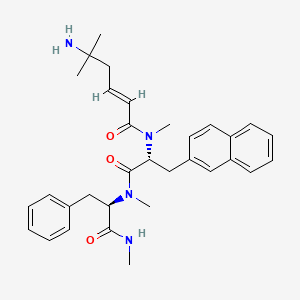
Tabimorelin
An experimental oral growth-hormone secretagogue with short human hormone studies and a demonstrated drug-interaction signal.
Short human pharmacology studies, including a clinically measured CYP3A4 interaction
Also known as: NN703
Practical use
Evidence interpretation and clinical context
- Separate hormone response from treatment benefit
- Look for the patient outcome beyond the blood measurement.
- Include interaction data
- A pharmacokinetic interaction is relevant even when an efficacy claim is unproven.
- Avoid assuming durable stimulation
- An initial response may change with repeated exposure.
Overview
Tabimorelin, also called NN703, was investigated as a way to stimulate growth-hormone release. Its published early human studies measured hormone responses and exposure rather than strength, disability or longevity.
Risks and limitations
A clinical interaction study found substantially greater midazolam exposure with tabimorelin, consistent with inhibition of CYP3A4 metabolism. The effect persisted into follow-up. This is a concrete interaction finding, not just a theoretical warning.
How to read this
An increase in growth hormone or IGF-1 establishes biological activity. It does not by itself demonstrate a useful treatment effect, and repeated stimulation may differ from the first response.
Research explained
The pharmacokinetics, pharmacodynamics, safety and tolerability following 7 days daily oral treatment with NN703 in healthy male subjects.
Who was studied
Healthy men in a randomized, double-blind, placebo-controlled study lasting seven days.
What was found
Growth-hormone responses and selected IGF-1 responses exceeded placebo, but overall growth-hormone release declined from the first to the seventh day.
What it cannot establish
The study measured hormones over one week. It did not establish improvement in strength, body composition, well-being or chronic disease.
Read the original studyA clinical study investigating the pharmacokinetic interaction between NN703 (tabimorelin), a potential inhibitor of CYP3A4 activity, and midazolam, a CYP3A4 substrate.
Who was studied
17 adult men in a pharmacokinetic study using midazolam as a CYP3A4 probe.
What was found
Midazolam exposure increased by 93% after repeated tabimorelin exposure and remained above baseline after the washout period.
What it cannot establish
The exact interaction magnitude cannot be assigned to every other CYP3A4 substrate. The result nevertheless shows that metabolism interactions occurred in people.
Read the original studyDevelopment boundary
The studies describe an investigational secretagogue. They do not document an approved tabimorelin indication or establish clinical benefit from the observed hormone changes.
Supporting sourceWhy the interaction study matters
A substance can alter another medicine’s exposure even when the first substance is marketed around a hormone or recovery claim. Interaction evidence deserves the same attention as hormone stimulation.
Supporting sourceClaims versus findings
Too narrow
An oral GH secretagogue acts only on GH signaling.
Tabimorelin also altered the exposure of a CYP3A4-metabolized probe medicine in a human study.
Check the evidenceCommon questions
Was the hormonal response constant with repeated exposure?
No. The seven-day study found lower overall GH release at the later assessment despite activity remaining above placebo.
SourceSources
Sources checked 2026-10-01.
General education; not a personal treatment plan.