

SARMs
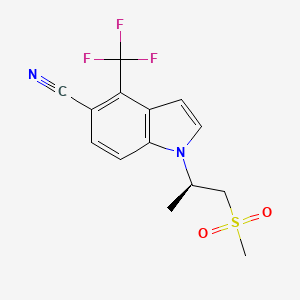
GSK2881078
A SARM tested in older adults and people with COPD, showing lean-mass effects and a qualified strength signal rather than broad functional improvement.
Randomized human trials; lean-mass improvement with mixed strength and patient-reported findings
Practical use
Evidence interpretation and clinical context
- Report the exact endpoint
- Keep relative and absolute strength findings distinct.
- Retain sex-specific uncertainty
- Do not transfer the male subgroup result to women.
- Include the background intervention
- Both trial groups also participated in home exercise.
GSK2881078, a SARM, Produces Dose-Dependent Increases in Lean Mass in Healthy Older Men and Women.
Overview
GSK2881078 is an androgen-receptor modulator investigated for muscle impairment. Its COPD trial paired the study drug or placebo with home exercise, so the comparison concerns an addition to that program.
Risks and limitations
Human studies reported transient liver-enzyme elevations and reductions in HDL cholesterol. Short studies cannot establish long-term cardiovascular safety, and a favorable body-composition result does not cancel these findings.
How to read this
A study may show a change in relative strength while its absolute-strength confidence interval includes no difference. Sex-specific results and the exact strength measure matter when describing this trial.
Research explained
Selective androgen receptor modulation for muscle weakness in chronic obstructive pulmonary disease: a randomised control trial.
Who was studied
97 adults with COPD, including 50 men and 47 postmenopausal women, in a 13-week randomized study with home exercise.
What was found
Men had a placebo-adjusted leg-strength percentage improvement of 7.0% with a 90% confidence interval of 0.5–13.6%. The absolute-strength interval included zero; women’s percentage-strength interval also included zero. Lean mass increased, while patient-reported outcomes did not improve.
What it cannot establish
The study was small, and the strength finding depended on sex and measurement. It does not establish reduced COPD disability, falls or hospitalizations.
Read the original studyGSK2881078, a SARM, Produces Dose-Dependent Increases in Lean Mass in Healthy Older Men and Women.
Who was studied
A randomized early trial in healthy older men and postmenopausal women lasting up to 53 days.
What was found
Lean mass increased in active groups, and women showed a greater response at lower exposure than men. Transient ALT elevations occurred.
What it cannot establish
Body composition was not proof of functional independence, and follow-up was too short for chronic safety conclusions.
Read the original studyRegulatory status
FDA states that SARMs are unapproved drugs, not dietary supplements.
Supporting sourceDo not combine unlike strength results
A percentage-change result, an absolute kilogram result and a patient-reported outcome should retain their individual uncertainty rather than being compressed into improved function.
Supporting sourceClaims versus findings
Not supported
GSK2881078 improved strength equally in men and women.
The COPD trial’s statistically positive percentage-strength finding was in men; the corresponding interval in women included no difference.
Check the evidenceCommon questions
Did added lean mass improve patient-reported outcomes?
The COPD report did not show improvement in those outcomes.
SourceSources
GSK2881078, a SARM, Produces Dose-Dependent Increases in Lean Mass in Healthy Older Men and Women.
Regulatory status — primary or official source
Sources checked 2026-10-01.
General education; not a personal treatment plan.