

Hormone medicines
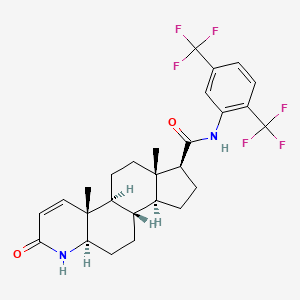
Dutasteride
An inhibitor of both major 5-alpha-reductase isoforms, with long persistence and important effects on PSA interpretation.
Established medical uses
Also known as: Avodart
Practical use
Applying the explained evidence
- Where it fits
- An inhibitor of both major 5-alpha-reductase isoforms, with long persistence and important effects on PSA interpretation.
- Put the information into practice
- A lower DHT or PSA number does not by itself establish a better overall clinical outcome. Tell the clinician interpreting PSA about dutasteride exposure.
- Diagnosis before a number
- Write down the symptoms, the reason a test was ordered, and the medicines already used. An isolated hormone result is a question to interpret, not a stand-alone reason to add another medicine.
- Keep this limit in view
- Total detection and high-grade detection were different outcomes. A reduction in overall biopsy detection does not establish a mortality benefit or justify preventive self-treatment.
Overview
Dutasteride inhibits conversion of testosterone to dihydrotestosterone through type 1 and type 2 5-alpha-reductase. Its U.S. product labeling concerns benign prostatic enlargement, rather than general protection from androgen-related effects.
Risks and limitations
Reported adverse effects include erectile difficulty, reduced libido, ejaculation changes and breast symptoms. Pregnancy exposure is contraindicated. The label also warns about increased high-grade prostate-cancer detection in prevention trials; it is not approved for prostate-cancer prevention.
How to read this
A lower DHT or PSA number does not by itself establish a better overall clinical outcome. Tell the clinician interpreting PSA about dutasteride exposure.
Research explained
REDUCE: biopsy-detected prostate cancer
Who was studied
6,729 men underwent biopsy or prostate surgery in a four-year randomized prevention study.
What was found
Cancer was detected in 659 of 3,305 dutasteride recipients versus 858 of 3,424 placebo recipients; reported relative risk reduction 22.8% (95% CI 15.2–29.8). In years 3–4, Gleason 8–10 tumors numbered 12 versus one.
What it cannot establish
Total detection and high-grade detection were different outcomes. A reduction in overall biopsy detection does not establish a mortality benefit or justify preventive self-treatment.
Read the original studyPSA can fall even when cancer is present
The label reports an average PSA reduction of about 50% within three to six months. That changes interpretation of the test. A confirmed increase from the lowest on-treatment PSA merits evaluation even when the result sits within the usual untreated reference range.
Supporting sourceA long half-life changes persistence
At steady state, the terminal half-life is approximately five weeks; measurable concentrations can remain for four to six months after discontinuation. CYP3A4 and CYP3A5 contribute to metabolism. These values describe pharmacokinetics, not the time required for every symptom or hormone effect to resolve.
Supporting sourceSources
REDUCE: biopsy-detected prostate cancer
PSA can fall even when cancer is present
A long half-life changes persistence
Sources checked 2026-09-28.
General education; not a personal treatment plan.