

Peptides and experimental biologics
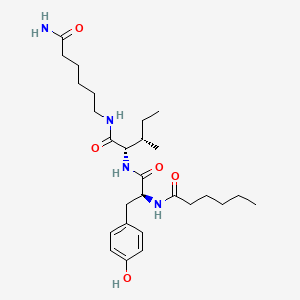
Dihexa
An experimental angiotensin-IV analog studied in cell and animal models. Promising findings coexist with negative experiments and a retracted mechanistic paper; human cognitive benefit is not established by these studies.
Preclinical findings · important retraction
Also known as: PNB-0408 · N-hexanoic-Tyr-Ile-(6)-aminohexanoic amide
Practical use
Applying the explained evidence
- Where it fits
- An experimental angiotensin-IV analog studied in cell and animal models. Promising findings coexist with negative experiments and a retracted mechanistic paper; human cognitive benefit is not established by these studies.
- Put the information into practice
- Separate direct Dihexa experiments from research on related molecules, especially fosgonimeton/fosgonimeton metabolites. Similar development history does not make compounds interchangeable. A human-cell experiment can carry human indexing terms without involving a treated human participant. Read the actual methods before labeling it a human trial.
- Check what was actually tested
- Match the exact molecule, formulation and study setting to the claim. Distinguish human outcomes from laboratory mechanisms and verify whether a cited paper actually tested the substance being discussed.
- Keep this limit in view
- The positive cognitive result summarized here is from a mouse model. It cannot establish improvement in human memory.
Overview
Dihexa is a synthetic molecule related to angiotensin IV, a signaling peptide. The interest is in neural signaling and plasticity, rather than testosterone, muscle growth or a conventional stimulant effect. Its research story is more complicated than “grows new connections”: experiments use different disease models, different biological endpoints and different levels of evidence. Results from cells, rodents and zebrafish answer distinct questions. None of the primary studies summarized here is a trial showing improved everyday cognition in people.
Risks and limitations
The studies below do not establish the frequency of side effects in people, a safe human exposure, or long-term safety. Laboratory effects involving cell-survival and growth pathways are not automatically beneficial in every tissue. They also do not quantify a human cancer risk. The correct conclusion is uncertainty, rather than either a cancer claim or reassurance that risk is absent. An online product bearing the name is not independently verified as matching the material used in research.
How to read this
Separate direct Dihexa experiments from research on related molecules, especially fosgonimeton/fosgonimeton metabolites. Similar development history does not make compounds interchangeable. A human-cell experiment can carry human indexing terms without involving a treated human participant. Read the actual methods before labeling it a human trial.
Research explained
An Alzheimer-like mouse model: a positive result
Who was studied
APP/PS1 mice, with wild-type and disease-model comparison groups; behavioral testing followed a three-month experimental period.
What was found
The authors reported better water-maze performance, changes in synaptophysin and inflammatory markers, and PI3K/AKT-associated signaling. A pathway inhibitor reversed some cellular effects.
What it cannot establish
A genetically altered mouse model is not human Alzheimer disease or healthy-person enhancement. The methods describe both intragastric and intraperitoneal administration, so route-specific claims should not be made from this report without resolving that inconsistency.
Read the original studyA Huntington-like rat model: no protection
Who was studied
40 male Wistar rats across vehicle, toxin-exposed and toxin-plus-PNB-0408 groups; five weeks of observation.
What was found
Dihexa, identified as PNB-0408, did not prevent the toxin-associated deficits in the outcomes examined.
What it cannot establish
A negative result in this model does not rule out every possible biological effect. It does show that favorable findings from one disease model cannot be assumed to transfer to another.
Read the original studyHair-cell protection in zebrafish
Who was studied
Larval zebrafish lateral-line hair cells exposed to aminoglycoside antibiotics.
What was found
The researchers observed protection against hair-cell injury. Blocking parts of HGF-associated signaling reduced the protective effect.
What it cannot establish
Fish sensory cells are a useful mechanistic system, not a clinical hearing-loss trial. This does not establish an effective or safe intervention for people receiving antibiotics.
Read the original studyNerve-repair research in rats
Who was studied
Rat sciatic-nerve transection and surgical repair; ten groups with approximately six to eight rats per group, followed for 16 weeks.
What was found
The study evaluated Dihexa, stem cells and growth-factor interventions as possible adjuncts to functional recovery after repair.
What it cannot establish
Multiple interventions, small groups and a surgical animal model limit attribution and translation. The abstract does not justify a human nerve-repair treatment or a precise benefit estimate.
Read the original studyHuman stem cells are not a human clinical trial
Who was studied
Human pluripotent stem cells differentiated into hepatic cells in laboratory work.
What was found
Dihexa was one component of a combination used during hepatic specification. The work investigated a cell-manufacturing method.
What it cannot establish
This is not evidence that taking Dihexa improves liver function or cognition. Outcomes from a multi-compound culture system cannot be assigned to a single ingredient in a person.
Read the original studyMechanism: separate the hypothesis from the evidence
Dihexa is often discussed in relation to hepatocyte growth factor (HGF), its receptor c-Met and downstream signaling. These are biological pathways involved in multiple tissues; their names are not a score for intelligence or recovery. A widely cited 2014 mechanistic paper is now indexed as a retracted publication. Its claims should not be presented as settled facts or used to give a precise potency ranking. Other experiments can be examined on their own merits, but their existence does not undo the retraction.
Supporting sourceResearch integrity changes the conclusion
A retraction is different from an ordinary study limitation. The 2014 paper remains useful for understanding the history of the claim, but it is flagged here rather than counted as reliable positive confirmation. Review the linked record and its retraction notice before repeating a mechanistic or potency claim. This is also why a long reference list is not equivalent to a strong evidence base.
Supporting sourceWhat pharmacokinetic numbers would need to tell you
A useful half-life or brain-penetration figure must name the species, formulation, route and measurement. The sources summarized here do not establish a validated human pharmacokinetic profile. Do not interpret an animal persistence claim as a human dosing interval. Chemical stability, blood concentration and duration of a behavioral effect are separate measurements.
What remains unknown about combinations
The reviewed experiments do not establish the safety of combining Dihexa with stimulants, hormones, other nootropics or experimental peptides. Shared pathway diagrams do not predict a safe combination. An interaction database with no entry would mean missing information, not compatibility.
A practical way to judge a Dihexa claim
First check the exact molecule. Next identify whether the source describes a treated person, an animal, a cell preparation or a review. Then ask whether the outcome was cognition, a molecular marker or an unrelated tissue effect. Finally check for a correction or retraction. That sequence prevents a cell-culture result from becoming an unsupported promise of human cognitive enhancement.
Human exposure and regulatory context
FDA states that it has not identified human exposure data for drug products containing Dihexa acetate through any administration route. That statement concerns the acetate material reviewed by the agency. Its inclusion on a compounding-risk page is not approval. A withdrawn nomination is also not a finding that a drug is safe.
Supporting sourceClaims versus findings
Not established by the reviewed studies
“It is proven to improve human memory.”
The positive cognitive result summarized here is from a mouse model. It cannot establish improvement in human memory.
Check the evidenceConflicting preclinical findings
“It works across neurodegenerative conditions.”
The rat Huntington-like model found no protection against the measured toxin-induced deficits. Disease models cannot be treated as interchangeable.
Check the evidenceCheck the methods
“Human studies in the references mean people took it.”
A paper using human stem cells studied cell differentiation. It did not administer Dihexa to people.
Check the evidenceCommon questions
Is Dihexa a SARM?
No. The primary research discussed here identifies it as an angiotensin-IV analog. That is a different research category from selective androgen-receptor modulators.
SourceDoes a promising mechanism prove a useful result?
No. A mechanism can motivate an experiment. Benefit still needs to be demonstrated for a specific population and outcome, followed by an adequate assessment of harms.
Why include a study that found no benefit?
Because a useful reference should show where the hypothesis failed as well as where it looked promising. Otherwise the article exaggerates how consistently the evidence supports the claim.
SourceSources
An Alzheimer-like mouse model: a positive result
A Huntington-like rat model: no protection
Hair-cell protection in zebrafish
Human stem cells are not a human clinical trial
Retracted HGF/c-Met paper and linked notice
FDA: Dihexa acetate human-exposure gap
Sources checked 2026-09-28.
General education; not a personal treatment plan.