

SARMs
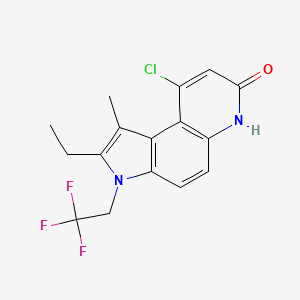
LGD-3303
A distinct experimental SARM studied in rats for bone and muscle effects; it should not be confused with LGD-4033.
Rat pharmacology and bone studies; no transferable LGD-4033 human evidence
Practical use
Evidence interpretation and clinical context
- Match every character in the name
- Check 3303 versus 4033 before using a citation.
- Read the selectivity experiment
- Tissue response and tissue concentration are separate measurements.
- Keep bone claims clinical
- Animal bone effects do not establish fracture reduction in people.
Overview
LGD-3303 and LGD-4033 are different molecules. LGD-3303 research examined androgen-responsive tissues and bone loss in rats. Human findings for Ligandrol cannot be reassigned to LGD-3303 because the names share an LGD prefix.
Risks and limitations
The cited studies do not establish human toxicity, reproductive recovery or a therapeutic window. Tissue selectivity in rats cannot validate the identity or safety of an online product.
How to read this
Selectivity can reflect how a drug activates its receptor, not simply where it accumulates. The LGD-3303 distribution experiment is useful because it tested that mechanistic explanation directly.
Research explained
Pharmacokinetics and pharmacodynamics of LGD-3303 [9-chloro-2-ethyl-1-methyl-3-(2,2,2-trifluoroethyl)-3H-pyrrolo-[3,2-f]quinolin-7(6H)-one], an orally available nonsteroidal-selective androgen receptor modulator.
Who was studied
Castrated-rat experiments measuring androgen-responsive tissues and drug concentrations.
What was found
LGD-3303 produced stronger anabolic than prostate responses. Prostate drug levels exceeded muscle levels, arguing against lower prostate exposure as the simple explanation for selectivity.
What it cannot establish
Organ response and tissue distribution are mechanistic endpoints, not human safety or performance results.
Read the original studyCombination treatment with a selective androgen receptor modulator q(SARM) and a bisphosphonate has additive effects in osteopenic female rats.
Who was studied
Ovariectomized rats in an experimental bone-loss study.
What was found
LGD-3303 improved several cortical and cancellous bone measures and muscle outcomes. The research also evaluated a separate combination arm with an antiresorptive medicine.
What it cannot establish
The study did not measure human fractures. The combination experiment does not establish a clinical combination or a self-treatment strategy.
Read the original studyRegulatory status
FDA states that SARMs are unapproved drugs, not dietary supplements.
Supporting sourceThe identity check
LGD-3303 results belong to LGD-3303. A claim citing a different LGD compound needs a separate evidence assessment.
Supporting sourceClaims versus findings
Incorrect compound match
LGD-4033 human trials validate LGD-3303.
The compounds are distinct; the cited LGD-3303 evidence here is from rats.
Check the evidenceCommon questions
Does selective mean the drug avoids the prostate?
Not in this experiment: prostate concentrations were higher than muscle concentrations despite smaller prostate responses.
SourceSources
Regulatory status — primary or official source
Sources checked 2026-10-01.
General education; not a personal treatment plan.