

Androgens
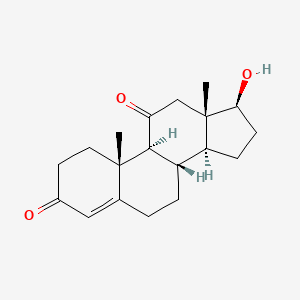
11-Ketotestosterone
A biologically active 11-oxygenated androgen studied in human disease and receptor models, without established enhancement benefits.
Cell experiments plus an observational prostate-cancer cohort; evidence checked 2026-10-01
Also known as: 11KT
Practical use
Evidence interpretation and concrete review questions
- Keep disease context
- Attach the patient group and treatment background to any quoted association.
- Read the uncertainty
- Report the confidence interval alongside the headline hazard ratio.
- Ask what would change care
- A new biomarker needs evidence that its measurement improves a decision.
11KT and progression after androgen deprivation
Overview
11-Ketotestosterone, or 11KT, is an androgen rather than an inactive waste product. Experiments with human androgen receptors and prostate-cancer cell lines found receptor-driven gene expression and cell growth. This is mechanistic evidence, not a treatment recommendation.
Risks and limitations
Androgen-receptor activity is relevant to hormone-sensitive disease. The available cohort cannot determine whether changing 11KT would improve outcomes, and it supplies no supplement safety boundary.
How to read this
Its main practical relevance here is interpreting disease-focused endocrine research rather than assuming every androgen is interchangeable with testosterone.
Research explained
11KT and progression after androgen deprivation
Who was studied
145 patients with recurrent nonmetastatic prostate cancer who achieved castrate testosterone levels; 31 developed castration-resistant disease.
What was found
Higher 11KT was associated with shorter time to resistance. The adjusted hazard ratio was 2.17, with a 95% confidence interval of 0.99–4.71.
What it cannot establish
Observational association with imprecise adjusted estimates; not proof that 11KT caused progression or that a specific intervention improves survival.
Read the original studyTestosterone does not describe every androgen
Cell studies showed that 11KT can activate androgen-receptor pathways even though it is a different molecule.
Supporting sourceKeep uncertainty in the numerical result
The adjusted confidence interval reached below one; this is not a precise doubling of risk for every patient.
Supporting sourceClaims versus findings
Too broad
A normal testosterone result excludes all androgen activity.
Other steroids can activate the receptor; the clinical relevance depends on the diagnosis and assay.
Check the evidenceCommon questions
Does this cohort prove 11KT should be lowered in everyone?
No. It studied a specific cancer population and did not randomize a treatment targeting 11KT.
SourceSources
11KT and progression after androgen deprivation
PubChem chemical identity; checked October 1, 2026
Additional primary or official source
Sources checked 2026-10-01.
General education; not a personal treatment plan.